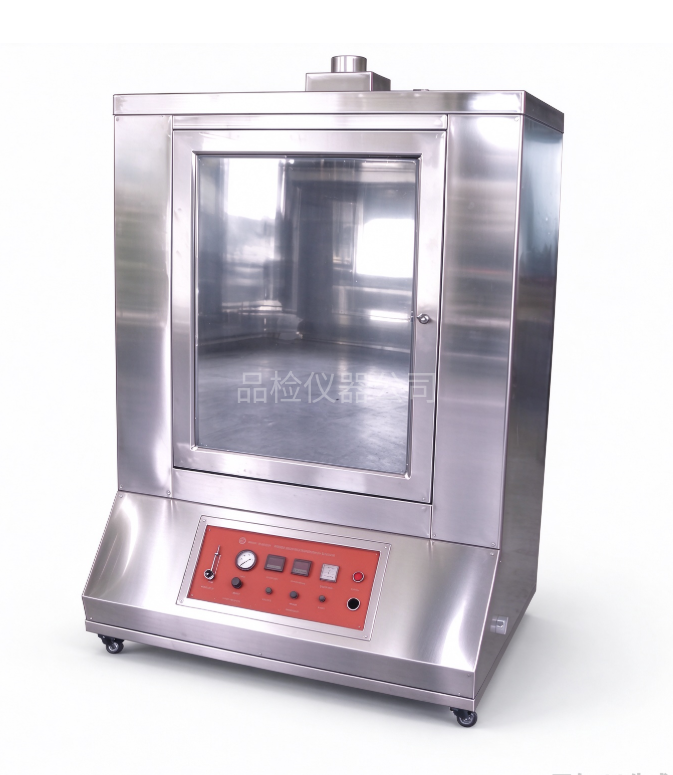
Vertical Foam Combustion Tester
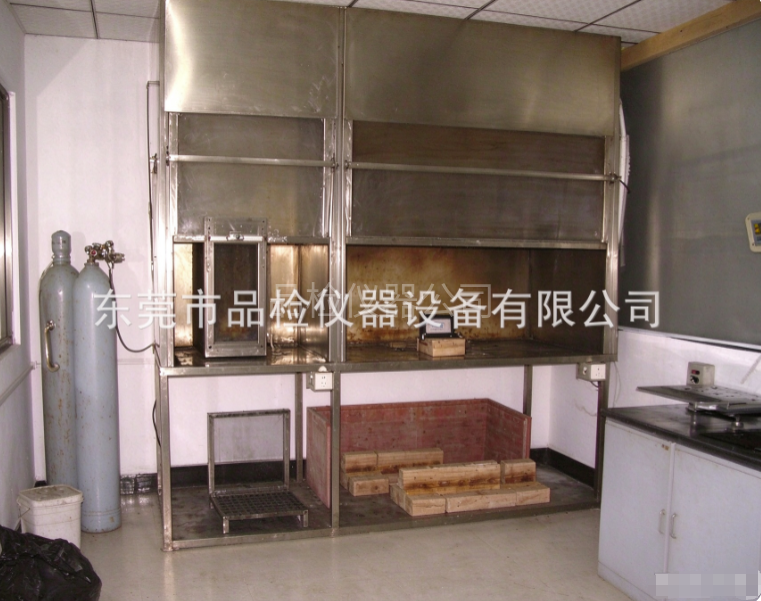
The Vertical Foam Combustion Tester complies with GB/T 8333–2022. It vertically fixes rigid foam plastic specimens inside a stainless-steel chimney equipped with an observation window. A Bunsen burner applies a flame for 10 seconds at a designated point. The instrument records maximum flame height, afterflame time, and residual mass percentage to evaluate the vertical combustion performance of rigid foam plastics under laboratory conditions.
| Model | QC-8333 |
|---|---|
| Size | 500*400*680mm |
| Weight | 30kg |
| Category | Foam Hardness, Fatigue, Resilience and Density Testing Machines |
| Burner Tube Inner Diameter | 9.5 mm ± 0.3 mm |
| Specimen Dimensions | 254 × 19 × 19 mm |
| Power Supply | 220 V |
| Test Method | Vertical Burning |
| Published | 2026-11-25 |
views:1
Overview
I. Equipment Overview:
This Vertical Foam Combustion Tester conducts standardized vertical flame application tests on rigid foam plastic specimens. The system comprises a stainless-steel chimney combustion chamber, specimen suspension fixture, calibrated Bunsen burner, precision timing unit, analytical balance integration, and integrated ventilation/safety controls. Specimens of standard dimensions are vertically mounted within the chimney; the Bunsen burner delivers a flame for 10 seconds at a defined angle and position. Key parameters recorded include afterflame time, maximum flame height, residual mass percentage (PMR), and flaming droplet count—enabling comprehensive assessment of vertical combustion behavior. Applications include R&D, incoming material inspection, and type testing. Fully compliant with GB/T 8333–2022.
II. Key Functions:
• Standardized Combustion Test: Applies flame at a 15° tilt for exactly 10 s per GB/T 8333–2022.
• High-Precision Timing: Records afterflame time with 0.1 s resolution.
• Flame Height Measurement: Quantifies maximum flame height via calibrated scale visible through observation window.
• Mass Evaluation: Integrates with analytical balance to weigh specimen and fixture pre- and post-test; calculates PMR.
• Droplet Assessment: Logs number of flaming droplets generated during combustion.
• Integrated Safety: Heat-resistant observation glass; interlocked fume hood (ventilation off during test, activated immediately post-test); gas shutoff valve.
• Data Management: Supports batch testing (6 specimens per group), automatic averaging, and standardized reporting.
III. Technical Specifications:
• Chimney: Rectangular stainless-steel cross-section; interior lined with 0.025 mm aluminum foil (except front observation panel); front panel: heat-resistant glass; calibrated scale mounted 51 mm above chimney base, 10 mm graduations, geometry per standard drawings.
• Specimen Fixture: Rear-hook suspension; three fixed pins (standard diameter); specimen top aligned with fixture and chimney top; pre-drilling optional for high-density foams.
• Bunsen Burner: Tube inner diameter: 9.5 ± 0.3 mm; fuel: ≥95% purity propane or natural gas; stable blue inner flame height: 25–35 mm; inner flame tip temperature: 960 ± 5 °C.
• Flame Application: 15° tilt from vertical; inner flame tip centered on specimen bottom edge; duration: 10 s.
• Timer: Resolution 0.1 s; stops automatically upon flame extinction; if extinguished within 10 s, recorded time remains 10 s.
• Specimen Dimensions: Rectangular, 254 ± 1 mm × 19.0 ± 0.5 mm × 19.0 ± 0.5 mm; six specimens per test group; specimens deviating >20% from group mean density are excluded.
• Conditioning: (23 ± 2) °C, (50 ± 10)% RH, minimum 24 h; testing must commence promptly after removal; storage under sealed conditions limited to ≤1 h.
• Ventilation Protocol: Ventilation disabled during test to ensure ambient air supply; activated immediately post-test to exhaust toxic smoke.
IV. Standardized Test Procedure:
1. Specimen Preparation & Screening: Cut six specimens from homogeneous material; surfaces smooth and dust-free; measure individual densities; exclude outliers exceeding ±20% deviation from group mean.
2. Conditioning & Weighing: Condition ≥24 h in standard environment; weigh each specimen (M); weigh fixture separately (S₁).
3. Mounting: Secure specimen onto three fixture pins; align top edges; pre-drill holes for high-density foams.
4. Chimney Setup: Line three interior walls with fresh 0.025 mm aluminum foil (flush with top/bottom edges); install heat-resistant glass; suspend fixture so specimen top aligns with chimney top. Replace foil after each test.
5. Burner Calibration: Ignite fuel; adjust air/gas ratio for stable blue flame; verify inner flame height and tip temperature.
6. Ignition Test: Position burner at 15° tilt; align inner flame tip with center of specimen bottom edge; start timer simultaneously with flame application; withdraw burner after 10 s.
7. Observation & Recording: Record maximum flame height (H); if exceeding scale, record as “250+ mm”; note presence/quantity of flaming droplets; record afterflame time (Tₑ); if extinguished within 10 s, Tₑ = 10 s.
8. Post-Test Weighing: After cooling, weigh fixture + residue (S₂).
9. Calculation: Compute residual mass percentage (PMR) using formula: PMR = [(S₂ − S₁) / M] × 100%.
10. Result Reporting: Report average specimen density, average afterflame time (rounded to nearest second), total flaming droplet count, average PMR (rounded to nearest integer), and average flame height (rounded to nearest 25 mm).
11. Final Report: Complies with Clause 8 of GB/T 8333–2022, including standard reference, material details, environmental conditions, all test results, deviations, and test date.
V. Calibration, Maintenance & Safety:
• Calibration: Regularly calibrate balance and timer; verify burner tube ID, flame morphology, and tip temperature; recheck scale and chimney geometry against drawings; retain calibration certificates.
• Maintenance: Replace aluminum foil liner before each test; clean fixture carbon deposits after every test; inspect gas lines for leaks periodically; keep observation glass clean for unobstructed viewing; maintain equipment logbook covering calibration, maintenance, and repairs.
• Safety: Combustion effluents contain toxic compounds; operators must wear safety goggles; fire extinguishers required onsite; gas supply must feature fail-safe shut-off valve; ensure full ventilation post-test.