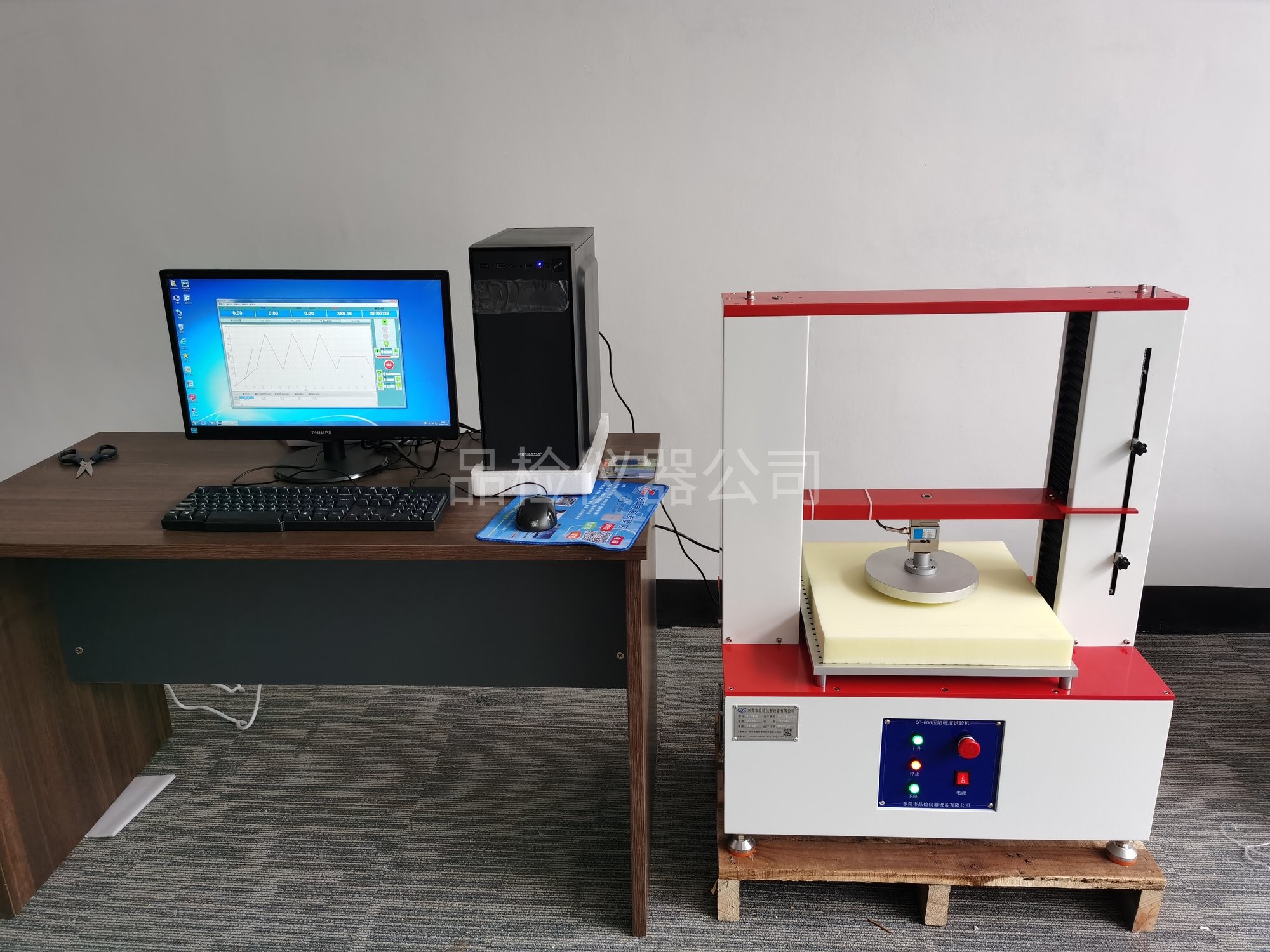
Slow-Recovery Foam Recovery Time Tester
The Slow-Recovery Foam Recovery Time Tester is a versatile instrument widely used to evaluate the compression characteristics and performance of sponge materials and soft polymeric foams. It supports research into foam material properties, enabling optimization of formulations and manufacturing processes. By assessing indentation hardness, manufacturers can select optimal foam materials to enhance product comfort and structural stability.
| Model | QC-606 |
|---|---|
| Size | 500*450*800mm |
| Weight | 150kg |
| Category | Foam Hardness, Fatigue, Resilience, and Density Testing Machines |
| Speed | 0.1–1000 mm/min |
| Maximum Stroke | 280 mm |
| Load Capacity | 2000 N |
| Motor Type | Servo Motor |
| Published | 2026-11-25 |
views:1
Overview
I. Equipment Overview
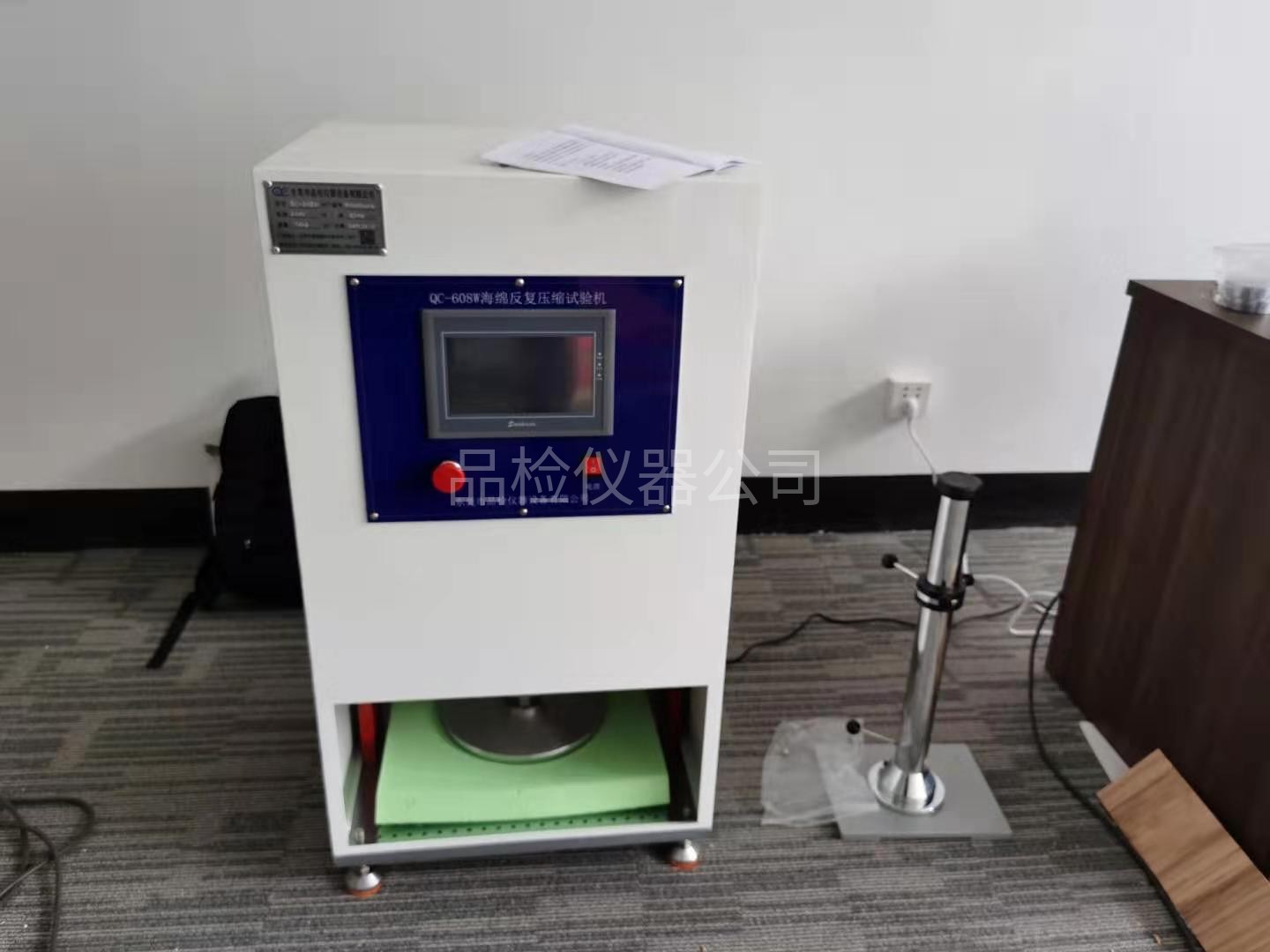
The QC-606 Slow-Recovery Foam Recovery Time Tester is developed in accordance with GB/T 26392-2011 'Slow-Recovery Foam — Determination of Recovery Time' (modified adoption of ASTM D3574-2008, Test Method M). It is a dedicated instrument for quantifying the time required for slow-recovery (memory) foam materials to return to their original shape after compression. The system comprises a flat platen indenter, load measurement unit, horizontally perforated support plate, compression drive mechanism, and integrated timing/data acquisition system. It automatically executes the full test sequence—including pre-load positioning, controlled compression, dwell, retraction, and recovery timing—providing objective, quantitative measurement of the 'slow-recovery' rate for R&D, incoming inspection, and final quality control.
II. Applicable Standards
- GB/T 26392-2011 'Slow-Recovery Foam — Determination of Recovery Time'
- ASTM D3574-2008, Flexible Cellular Materials — Test Method M (Recovery Time)
- Conditioning per GB/T 2918; Dimensional measurement per GB/T 6342
III. Applications
Designed for determining recovery time of various slow-recovery (memory) polyurethane foams, molded memory foams, and related soft porous materials. Widely applied in performance evaluation and material grading for memory foam pillows, mattresses, seat cushions, lumbar supports, automotive interior components, and protective packaging.
IV. Test Principle
A defined indentation force is applied to the specimen to achieve a specified deformation, held for a set duration, then released. Upon retraction of the indenter, the time required for the specimen to recover sufficiently to reapply a predefined preload (4.5 N) onto the indenter is measured and reported in seconds (s), directly characterizing the material’s recovery speed.
V. Key Technical Specifications
Compliant with GB/T 26392-2011 (equivalent to ASTM D3574 Test Method M)
Indenter Type: Circular flat platen, Ø203 mm, connected via flexible swivel joint to load system
Compression Speed: (1000 ± 100) mm/min (constant-speed compression and retraction)
Preload: 4.5 N (used for both initial thickness determination and recovery endpoint detection)
Compression Depth: 75% of specimen’s initial thickness
Dwell Time: 60 s
Retraction Position: Returns to position corresponding to 5% deformation of initial thickness
Timing Method: Timer starts upon indenter retraction initiation; stops when specimen re-applies 4.5 N load to indenter
Recovery Time Unit: Seconds (s)
Support Plate: Perforated horizontal plate, hole diameter ≈ 6.5 mm, center-to-center spacing 20 mm (ensures air egress)
Specimen Dimensions: ≥ 380 mm × 380 mm × 100 mm; if thickness ≠ 100 mm, explicitly stated in report; parallelism tolerance ≤ 1%
Specimen Quantity: 1 piece (or as agreed between supplier and user)
Conditioning Environment: 23 ± 2°C, 50 ± 10% RH, minimum 16 h conditioning, followed by testing under identical conditions
Optional Configurations: Automatic thickness measurement, force-time curve acquisition, touchscreen control, data storage & printing
Note: Indenter diameter, support plate hole size/spacing, compression depth, dwell time, and preload are all fixed per standard requirements. Load capacity, number of test stations, and data output formats are customizable upon request.
VI. System Components
1. Flat Platen Indenter Assembly: Ø203 mm circular plate with swivel joint ensuring uniform surface contact;
2. Load Measurement Unit: High-precision sensor detecting 4.5 N preload and recovery endpoint load to trigger timing start/stop;
3. Compression Drive Mechanism: Precision-controlled vertical motion at (1000 ± 100) mm/min for both compression and retraction;
4. Horizontally Perforated Support Plate: Uniformly distributed Ø6.5 mm holes on 20 mm centers, facilitating rapid air evacuation from beneath specimen and eliminating air-cushion interference;
5. Control & Timing System: Automatically records initial thickness, compression stroke, dwell duration, and recovery time; supports data storage and reporting.
VII. Key Features & Capabilities
- Full Standard Compliance: Indenter diameter, compression speed, compression ratio (75%), dwell time (60 s), and 4.5 N endpoint criterion strictly adhere to GB/T 26392-2011;
- Fully Automated Workflow: Preload positioning → 75% compression → 60 s dwell → retraction → automatic timing — executed with one command;
- Objective Endpoint Detection: Recovery completion is determined solely by restoration of 4.5 N load, eliminating subjective visual assessment;
- Auto Thickness Recognition: Initial thickness measured under 4.5 N preload; compression stroke calculated automatically as 75% of that value;
- Optimized Air-Egress Support: Precision-perforated plate ensures consistent, stable test results;
- Traceable Data Management: Recovery time, specimen thickness, test date, and other parameters stored, exportable, and printable.
VIII. Test Procedure
1. Specimen Preparation: Minimum dimensions 380 mm × 380 mm × 100 mm; parallelism tolerance ≤ 1%; arbitration specimens must be ≥ 7 days post-production;
2. Conditioning: Minimum 16 h at 23 ± 2°C and 50 ± 10% RH, with testing conducted in the same environment;
3. Specimen Placement: Place specimen centrally on perforated support plate;
4. Preload Positioning: Lower indenter until 4.5 N preload is achieved; record initial thickness;
5. Controlled Compression: Compress at (1000 ± 100) mm/min to 75% of initial thickness; hold for 60 s;
6. Retraction & Timing Initiation: Retract indenter at same speed to position corresponding to 5% of initial thickness; timer starts simultaneously;
7. Endpoint Detection: Timer stops when specimen re-applies 4.5 N load to indenter; record recovery time (s).
Note: If the specimen remains adhered to the indenter base during retraction, the result is invalid and the test must be repeated.
IX. Reporting & Results
Recovery time is reported in seconds (s). The test report shall include: applicable standard number, material identification, specimen thickness (if non-standard), measured recovery time (s), any deviations from the standard or un-specified procedural details, environmental conditions, and test date.
X. Typical Applications
- Final quality assurance and incoming material verification for memory foam manufacturers;
- Comparative R&D of recovery kinetics across formulations, densities, and processing parameters;
- Comfort and resilience evaluation of soft goods including pillows, mattresses, seat cushions, and lumbar supports;
- Performance grading of automotive interior foams, vibration-damping components, and protective packaging foams.