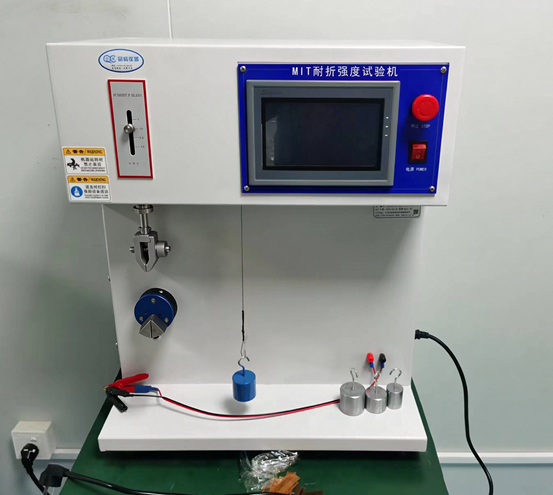
Touchscreen-Controlled MIT Folding Endurance Tester
The MIT Folding Endurance Tester is a specialized instrument designed to evaluate the resistance of paper products and thin metallic materials to repeated folding fatigue. Widely used in quality control across pulp & paper, printing & packaging, consumer electronics, and metal foil manufacturing industries, it provides standardized testing support for material formulation optimization and product reliability validation. Compliant with ISO 5626, JIS P 8115, R 3420, C 5016*, ASTM D2176, and TAPPI T511.
| Model | QC-1819 |
|---|---|
| Size | 450*350*450mm / |
| Weight | 35kg |
| Category | Fatigue Life Testing Machine |
| Folding Count Range | 0–9,999,999 cycles |
| Folding Speed | 80–175 ±10 cycles/min (adjustable) |
| Published | 2026-11-19 |
views:6
Overview
Overview:
The Touchscreen-Controlled MIT Folding Endurance Tester is a dedicated instrument for evaluating the folding fatigue resistance of paper and thin metallic materials. It is widely deployed in quality assurance processes across pulp & paper, printing & packaging, consumer electronics, and metal foil manufacturing industries—supporting standardized testing for material formulation optimization and product reliability verification. Compliant with ISO 5626, JIS P 8115, R 3420, C 5016*, ASTM D2176, and TAPPI T511.
Technical Specifications:
1. Folding Count Range: 0–9,999,999 cycles
2. Folding Angle: 0–175° ±1° (preset options: 45°, 90°, 135°); configurable for single-side or bilateral angles; custom angles available for fiberglass and other specialty materials
3. Folding Speed: 80–175 ±10 cycles/min (adjustable)
4. Folding Head Width: 19 ±1 mm; Fold Radius: 0.38 ±0.02 mm (custom radii available for fiberglass and other materials)
5. Standard Weights: One each of 4.9 N, 9.8 N, and 14.7 N (custom weights available upon request)
6. Human-Machine Interface: 7-inch touchscreen display with real-time cycle counting
7. Electrical Continuity Monitoring: Resistance range 0.1–100 Ω (user-configurable threshold); automatic shutdown if resistance exceeds set limit
8. Operating Environment: Temperature 0–35 °C; Relative Humidity <85%
9. Dimensions (W×D×H): 450 × 350 × 450 mm
10. Weight: 35 kg
11. Power Supply: AC 220 V, 50 Hz
12. Note: Conductivity testing and resistance monitoring are mutually exclusive modes
13. Motor: Closed-loop stepper motor
Operating Procedure:
During testing, operators first prepare specimens per applicable standards. Specimens are conditioned under standard atmospheric conditions (23 °C ±1 °C, 50% RH ±2%) prior to cutting. At least ten longitudinal and ten transverse specimens—each 15.0 ±0.1 mm wide and ≥140 mm long—are prepared. After leveling the instrument, the required weight load is applied. Specimens are vertically clamped between the folding head jaws, ensuring spring tension indicators align with preset marks. Upon initiation, the tester performs controlled reciprocating folds at the specified angle and speed. A counter records double-fold cycles in real time. When specimen rupture occurs at the fold line, the tester automatically logs the final cycle count. The counter resets for subsequent tests. Upon completion of all specimens, the system calculates and outputs either the arithmetic mean of double-fold counts—or the mean of base-10 logarithms of double-fold counts—for longitudinal and transverse specimens separately.
Product Videos
cefac70a8854e316b22bca69060c59f7