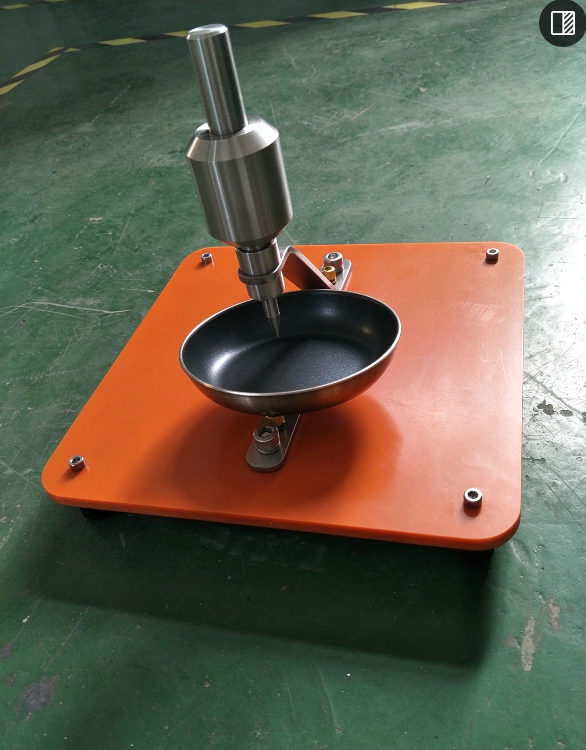
Non-Stick Coating Peel Adhesion Tester for Cookware
The Non-Stick Coating Peel Adhesion Tester evaluates peel adhesion of non-stick coatings on cookware; the vertical distance of coating delamination from the cut edge must not exceed 6 mm.
| Model | QC-9050 |
|---|---|
| Size | 刮刀0.43mm |
| Weight | 0.2kg |
| Category | GB/T 32095 Metal Cooking Utensil Testing Equipment |
| Blade Thickness | 0.43 ± 0.03 mm |
| Base Material | Phenolic resin board (orange bakelite) or aluminum plate |
| Scribing Angle | Fixed 90° (perpendicular to coating surface) |
| Standard Cut Width | 1.5–3.0 mm (interchangeable blades) |
| Standard Cut Length | 30–50 mm (fixture-controlled) |
| Pressure Head Configuration | Calibrated stainless-steel weighted structure |
| Specimen Compatibility | Flat coated panels and curved coated surfaces (e.g., pot body/bottom) |
| Standard Base Dimensions | 300 × 300 mm (customizable) |
| Leveling Mechanism | Adjustable non-slip leveling feet |
| Blade Type | Standardized utility knife blade |
| Measured Parameter | Vertical height of coating delamination |
| Published | 2026-11-19 |
views:7
Overview
I. Product Overview
The Non-Stick Coating Peel Adhesion Tester is a manual test fixture designed to assess the peel adhesion strength of non-stick coatings on cookware—including frying pans, saucepans, and other coated utensils. It implements standardized coating peel testing procedures per relevant specifications, simulating the prescribed cross-hatch cutting and right-angle peel inspection steps. By replacing manual knife handling, it ensures consistent cutting force and angle, significantly reducing operator-induced variability. It is suitable for incoming material inspection, final product quality control, and laboratory-type certification testing.
The fixture base is constructed from high-temperature-resistant phenolic resin board (orange-colored bakelite), offering excellent rigidity, electrical insulation, and dimensional stability. The scribing pressure head features a stainless-steel weighted structure that maintains precise 90° perpendicular alignment of the blade relative to the specimen surface. Integrated positioning fixtures accommodate both flat test panels and curved surfaces (e.g., pot body or bottom), enabling reliable manual thumbnail peel testing and subsequent measurement of coating lift height.
Test Principle: A standardized utility knife with a defined blade geometry is used to make a straight cut perpendicular (90°) to the coating surface, achieving a specified cut length. The coating is then peeled vertically upward along the cut edge using the thumbnail. The resulting vertical height of coating delamination is measured—typically with a ruler or digital caliper—to determine whether peel adhesion meets acceptance criteria.
II. Key Technical Specifications
Blade Thickness: 0.43 ± 0.03 mm
Base Material: Phenolic resin board (bakelite) or aluminum plate
Scribing Angle: Fixed 90° (blade perpendicular to coating surface)
Standard Cut Width: 1.5–3.0 mm (achieved via interchangeable blades)
Standard Cut Length: 30–50 mm (controlled by fixture-positioning stops)
Pressure Head Weight: Standard calibrated weights ensure consistent scribing force
Specimen Compatibility: Flat coated panels; curved coated surfaces (e.g., pot sidewalls or bottoms)
Base Dimensions: Customizable (standard: 300 × 300 mm)
Leveling Mechanism: Adjustable non-slip leveling feet for stable operation on uneven workshop floors
Blade Type: Standardized utility knife blade per test method requirements
Measured Parameter: Vertical height of coating delamination (measured using ruler or digital caliper)